In discussion with Dr Christian Spring, Principal Scientist

The challenge facing sports turf managers isn’t simply that we don’t have enough water. It is that we aren’t always equipped to capture, store, retain and make the most of the water when it is available.
With nine water companies across England currently operating restricted-use bans, and some regions including parts of Surrey, Hampshire and Berkshire facing restrictions for the first time in 14 years, water resilience is becoming an increasingly important consideration for sports facilities. The Environment Agency’s National Drought Group has described 2026 as a second consecutive summer drought, with more than half of the country officially in drought status and some areas recording their driest July on record.
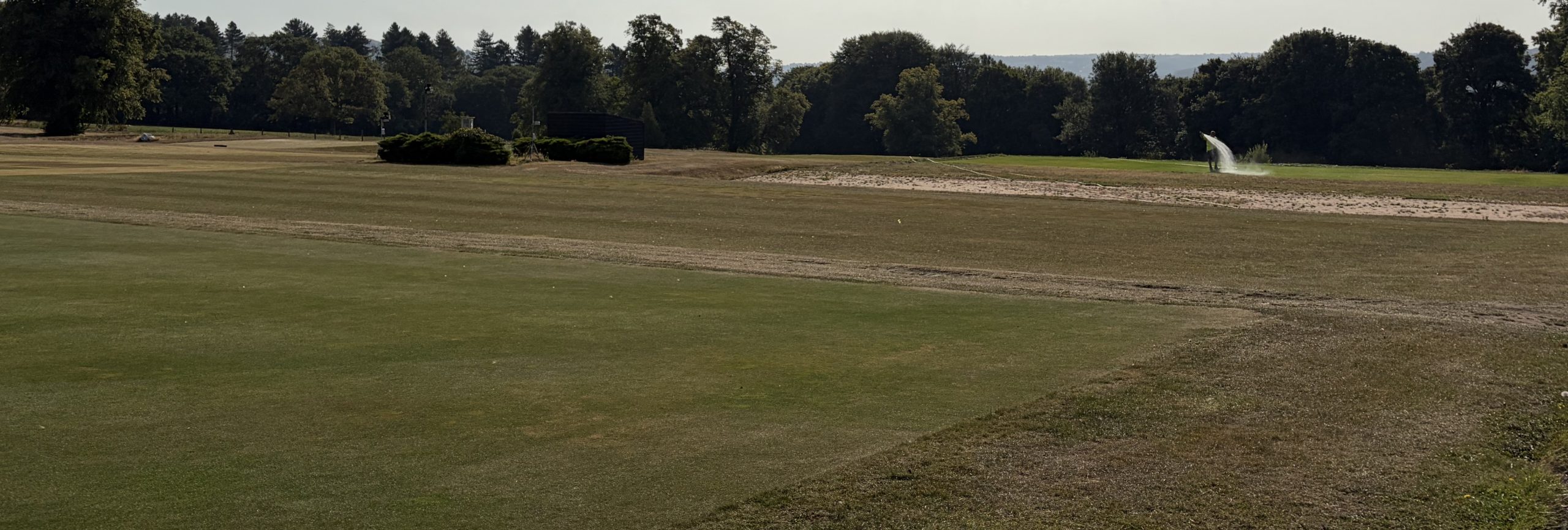
The Met Office has also reported July 2026 as the second warmest July on record, at 2.1°C above the 1991–2020 average, as well as the sunniest July on record. For natural turf, the combination of heat, high light intensity and prolonged periods without rainfall can place significant additional stress on playing surfaces.
For most households, water restrictions may mean watering cans instead of hosepipes. For sports turf managers, the implications are much greater. How do you keep a golf green smooth and true, a football pitch playable, or a racecourse safe for horses when water availability is increasingly uncertain?
The water paradox
Water resilience isn’t simply about using less water. It is about capturing more of the water we receive, retaining it for when it is needed and applying it intelligently.
Sports venues can consume significant volumes of water during periods of high demand. Across approximately 820 English golf courses that directly abstract water, estimated summer irrigation demand can reach around 24 million litres per day. On a football or rugby pitch measuring 68m × 110m, just 3mm of irrigation represents approximately 22,400 litres of water – an illustrative calculation that demonstrates how quickly demand can accumulate.
These figures highlight why water needs to be considered as a strategic resource rather than simply something delivered through an irrigation system.
Changing weather patterns are making this increasingly complex. Longer periods of drought are being interspersed with more intense, short-duration rainfall events. After prolonged dry weather, hard or compacted ground can limit infiltration, meaning significant rainfall can run off the surface rather than replenishing the soil profile or being captured for future use.
At the same time, expectations of playing quality continue to rise. Sports surfaces are expected to perform consistently throughout longer seasons, withstand greater usage and remain safe for athletes and horses, often with fewer available resources.
Managing the whole water cycle
Effective water management starts long before irrigation systems are switched on. It requires an understanding of the entire water cycle across a venue:
Capture → Store → Retain → Use → Recycle
That means asking fundamental questions about how water moves around the site.
Can roofs and hardstanding provide a source of harvested rainwater?
Can drainage infrastructure direct water towards storage rather than discharge? Is there sufficient reservoir capacity to bridge prolonged dry periods? Can the rootzone retain more of the water that falls? Can irrigation systems apply water precisely where it is needed? Are there alternative sources that could reduce reliance on potable water?
These considerations need to work together. Improving irrigation efficiency, for example, will have limited impact if a venue has inadequate storage capacity or loses significant volumes of rainfall through inefficient drainage.
The condition and composition of the playing surface are equally important. Infiltration rates, compaction, rootzone composition, organic matter, grass species and maintenance practices can all influence how effectively water enters, moves through and remains within the soil profile.
During periods of drought, irrigation should therefore be closely matched to evapotranspiration and actual soil moisture demand rather than applied according to a fixed schedule. Soil moisture monitoring, hyperlocal weather forecasting and data-driven irrigation scheduling allow grounds teams to make decisions based on measured plant and soil requirements rather than habit or assumption.
No two venues are the same
There is no single water management solution for sport.
A racecourse balancing ground conditions and equine welfare faces very different pressures to a golf course managing greens under restricted water availability, or a football stadium preparing a pitch for a televised fixture with only days to recover.
Every venue has its own climate, topography, surface composition, drainage infrastructure, water sources, storage capacity and operational requirements. Understanding these characteristics is critical to developing a strategy that is both practical and resilient.
The first step isn’t necessarily investing in new infrastructure. It is understanding what climate change means for your individual venue.
Where will your water come from? Where does it currently go? How long can your existing storage sustain the playing surface through a prolonged dry period? What happens when heavy rainfall follows drought?
Resources such as the BBC’s local climate projections, the Golf Water Map and the Met Office’s Get ClimateReady programme can provide useful insight into the challenges individual locations may face. However, translating that information into a practical water management strategy requires an understanding of the specific venue and its operational demands.
Building resilience for the future
At STRI, we work with sports venues across the UK and internationally to develop long-term water management strategies that improve resilience while protecting playing quality.
Our expertise spans irrigation design, drainage engineering, agronomy, surface performance, environmental consultancy and climate adaptation, allowing us to consider water management from the playing surface through to the wider site.
For racecourses, we have also developed a Best Practice Guide for Water Management, providing practical guidance to support consistent ground conditions while safeguarding horse welfare. Many of the principles within the guide are equally relevant across other sports, where careful planning and evidence-led decision making are becoming increasingly important.
While hosepipe bans may dominate today’s headlines, water resilience is not a challenge that will disappear when rainfall returns. Climate change is likely to continue bringing greater variability, with sports venues needing to prepare for both prolonged dry periods and increasingly intense rainfall events.
The facilities that invest in understanding their water resources today – measuring them, modelling them and managing them strategically – will be best placed to maintain high-quality, sustainable playing surfaces in the years ahead.
Water resilience isn’t simply about using less water. It is about capturing more of the water we receive, retaining it for when it is needed and applying it intelligently.
If your sports facility is reviewing its water management strategy, looking to improve irrigation efficiency or planning for greater long-term climate resilience, STRI’s consultants can help.