
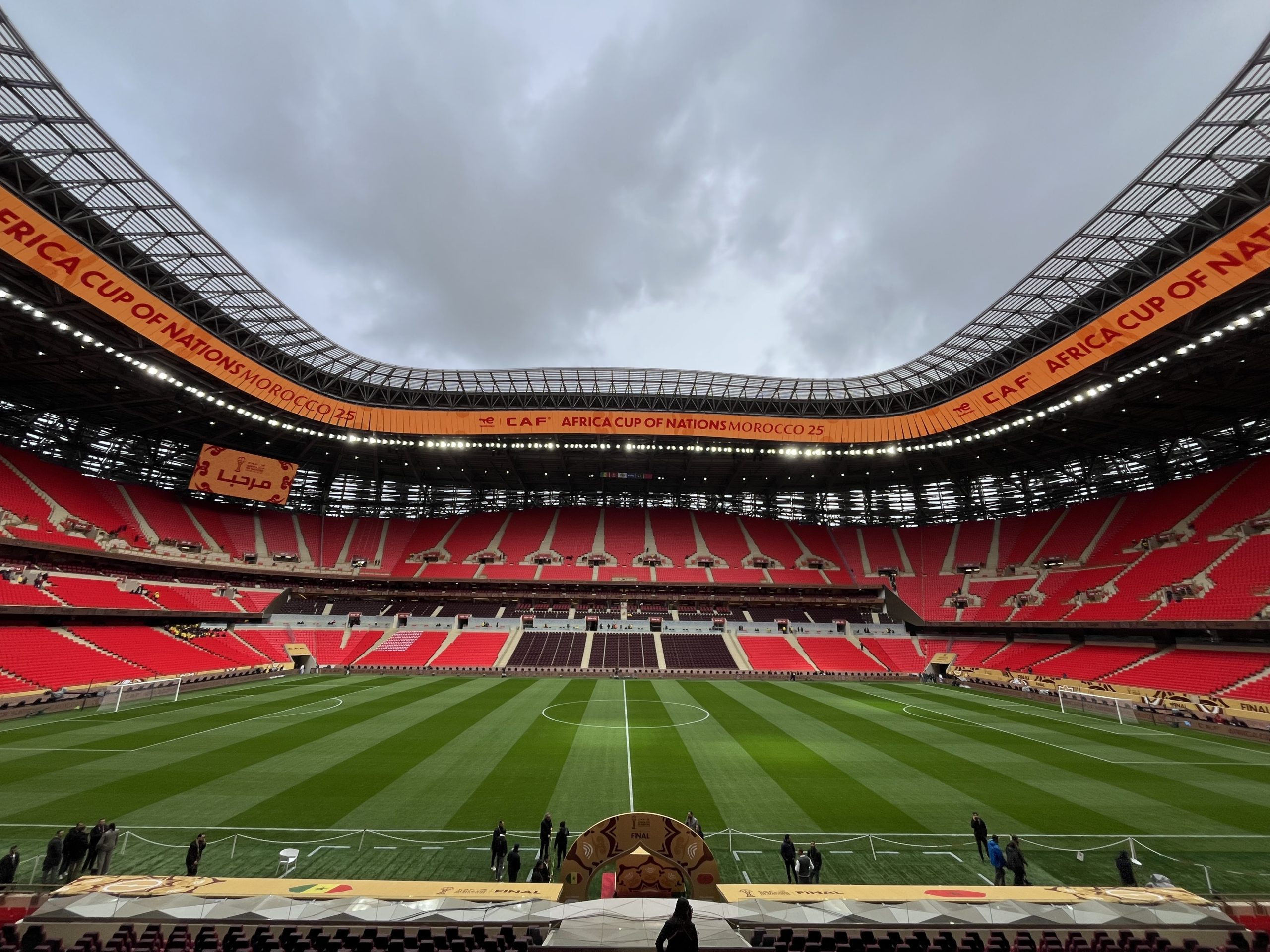
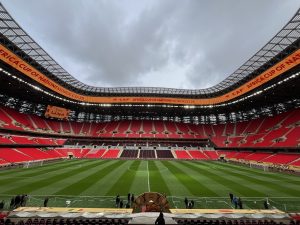
Prince Moulay Abdellah Stadium, AFCON 2025
scroll
Services
Project summary
Pre-construction advisory
FIFA pitch testing
Construction monitoring
Tournament support
The Africa Cup of Nations (AFCON) is the premier international football tournament on the continent, bringing together Africa’s top national teams. Held every two years under the Confederation of African Football (CAF), AFCON is renowned for its intensity, passion, and ability to showcase emerging talent alongside established stars. Beyond the football, the tournament delivers significant economic, cultural, and media impact for host cities, placing venues under major scrutiny.
STRI’s consulting team was appointed to provide end-to-end technical support for the preparation and performance of the natural turf football pitch at Prince Moulay Abdellah Stadium in Rabat, Morocco for the African Cup of Nations. STRI’s involvement began with the review of design and construction documents, pre-construction advisory services, and construction monitoring to ensure the new surface was built to the highest standards.
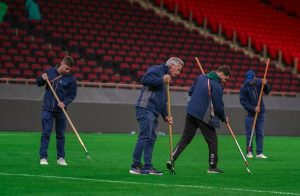
Working in close collaboration with VALTECH, stadium operators and local teams, STRI remained embedded throughout the project. Providing on-site support, ensuring the pitch consistently met full FIFA requirements for quality, playability and resilience under the demands of a major international tournament.
the
challenge
Preparing the playing surface for AFCON presented a number of technically complex and dynamic challenges.
Morocco experienced unusually heavy winter rainfall following seven years of drought, requiring rapid adaptation of maintenance strategies and the implementation of effective measures to manage excess moisture and protect surface performance. At the same time, the pitch was undergoing the high-risk transition from a warm-season C4 species (Paspalum) to a cool-season C3 species (Perennial Ryegrass).
Compounding this were the operational pressures of delivering a fully functional playing surface within a stadium that was under construction. STRI worked within extremely tight timescales while coordinating alongside ongoing tournament preparation works, including cranes operating on and around the pitch, restricted access routes, and major installation activities such as roof-mounted screen assembly.
The limited size of the stadium’s oculus further constrained grass growth by reducing natural light penetration, requiring a carefully considered agronomic management plan to maintain turf health and surface uniformity.
STRI collaborated directly with the ceremonies team to safeguard the pitch throughout rehearsals and live show elements associated with the opening and closing ceremonies. These activities placed intense, concentrated loads on the surface and required real-time monitoring and tailored protection strategies to ensure the pitch remained resilient for match play.

the
solution
STRI implemented a comprehensive, data-led approach to support both short-term performance and long-term resilience. This informed tailored maintenance activities which ensured the surface consistently met the required performance standards. Comprehensive daily and match day testing was conducted, consisting of surface hardness, volumetric moisture content, grass height, grass coverage and rotational resistance (traction).
A full programme of construction monitoring and pre-tournament preparation ensured the pitch was delivered to FIFA Quality Programme standards ahead of the competition. Prior to construction, STRI reviewed relevant specification documents and provided pre-construction advice followed by oversight of construction initiation. This process ensured the project progressed as smoothly as possible. On-site presence during the construction monitoring of the project allowed for factual decision making, contingency and stop/start scenario planning, consistent reporting and quality checks. Following the construction and hybrid stitching, STRI carried out a full FIFA test on the pitch as per the test manual for natural playing surfaces “FIFA Quality Programme for Natural Playing Surfaces” October 2021.
Advanced systems, including a vacuum and ventilation system, an elite standard irrigation system for optimal coverage, geocell layer and turf fans were all deployed as part of an integrated approach to surface performance and turf health. Additional LED lighting rigs were introduced to support turf health during periods of low natural light.
To mitigate the impact of ceremonies and rehearsals, STRI coordinated closely with all stakeholders to deliver a comprehensive pitch protection strategy, including the use of full-surface covers and artificial turf in high-wear areas such as stage access points. Rehearsals were carefully managed, with activity redirected to external venues where possible.
Match day warm-up pitch protection maps and plans were distributed to all stakeholders, including home and away teams, to ensure high wear areas of the pitch were protected to ensure high-wear areas of the pitch were identified and protected in advance of kick-off.
STRI attended post-match briefings to review pitch conditions, assess the impact of high-risk activities on the surface, and ensure appropriate control measures were in place to protect the playing surface throughout the tournament duration.
Throughout the project, STRI maintained close collaboration with CAF, general coordinator (GC) contractors and stadium teams, ensuring consistent alignment and clear communication at every stage. Drawing on extensive experience delivering surfaces for major international tournaments, including FIFA World Cup venues, STRI developed and continuously refined detailed maintenance schedules, matchday protocols and staffing strategies to meet the evolving demands of the project.

the
results
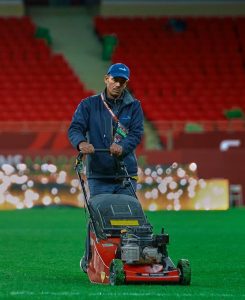
The playing surface performed consistently throughout the tournament, supporting elite-level football across all fixtures and events.
The pitch successfully hosted:
- Seven matches
- Two extra-time fixtures
- One penalty shootout
- One match day-2 training session
- Opening and closing rehearsals and ceremonies, including staging and large-scale performances
The success of the surface is a testament to the expertise and dedication of STRI’s on-site consultancy team, Colin Lyons, Stella Rixon, Mark Murphy and Joe Woodcock who worked in close partnership with local stakeholders to support both day-to-day agronomic operations and long-term performance outcomes.
STRI’s Colin Lyons, commented, “Delivering consistency and playability under tournament conditions, particularly in the face of extreme weather and complex agronomic transitions, is a remarkable achievement given the environmental and operational complexity of this project. This project demonstrates the value of expert, on-site consultancy and the commitment of our team in supporting world-class sporting surfaces.”
The stadium is set to play a significant role on the global stage, having been selected as a host venue for the FIFA World Cup 2030 across Spain, Portugal and Morocco.
The pitch not only meets FIFA’s stringent requirements for the 2030 tournament but also delivered immediate performance at the highest level, successfully supporting the demands of the AFCON 2025 Final. This dual focus on long-term compliance and short-term excellence highlights STRI’s ability to deliver surfaces that perform under the most intense international scrutiny.
let’s start our conversation today
If you’ve got a question, or would like us to help you with a project, we’d love to hear from you. Complete the form, give us a call or come and see us.