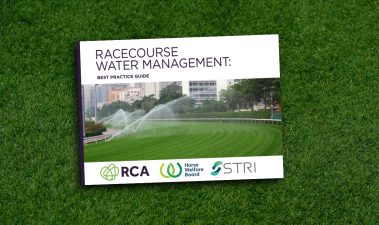
Water is a precious resource and extremely important for managing consistent and high-quality racing surfaces. Recognising this, STRI has authored best practice guidance on racecourse water management, which was officially launched to Clerks of Course and grounds professionals at the RCA Medical, Veterinary and Turf Management conference on the 28th January.
The guide has been developed by STRI in partnership with the Horse Welfare Board (HWB) and the Racecourse Association (RCA), with support from the RCA Ground and Going Group and funding generously provided by The Racing Foundation. Together, this collaboration reflects a shared commitment to improving consistency, resilience and welfare across UK racecourses.
In sport, we can no longer rely on historic climate trends alone to guide how natural turf courses are managed. The impacts of prolonged drought, intense rainfall and poor drainage can be significant, affecting both surface performance and welfare. To meet these challenges, racecourses must be adaptive, flexible and prepared, with the right infrastructure in place and teams who can make informed, confident decisions about their tracks.
Who is the guide for?
The guidance is primarily aimed at Clerks of Course and grounds staff, but it is equally relevant for racecourse executives and decision-makers responsible for investment, planning and risk management. Importantly, it has been designed to be accessible to both technical and non-technical audiences, ensuring it can be understood and applied across all levels of racecourse operations.
The document also provides a valuable training resource for staff who are new to racing or racecourse management. At its core, the guide prioritises the welfare of horses and jockeys by supporting the delivery of the desired Going and the development of strong, healthy turf to achieve optimal racing conditions.
Background to the guidance
In 2024, STRI developed a Performance Quality Standard (PQS) for turf racecourses, highlighting the growing need for robust data measurement to support an enhanced and insightful approach to surface management. A key component of this has been the objective assessment of soil water content and how this relates to irrigation demand, application and water availability.
As the volume of measurements taken from racecourses has grown, this has allowed irrigation requirements to be calculated with greater accuracy. Central to this work has been improving understanding of the relationship between soil moisture and firmness, or Going, on a racecourse.
Building on this foundation, the Racecourse Water Management: Best Practice Guide brings together this knowledge into a clear, practical document that provides straightforward guidance on soil behaviour, water availability and irrigation demand.
What’s included in the guide?
The guide covers key principles of racecourse water management, including how soil and water interact and the impact this has on drainage and irrigation, how different soil types influence irrigation demand, how to calculate how much irrigation water is required, why measuring soil moisture content is essential to informed decision-making and why strategic thinking on water availability is essential for racecourse operations.
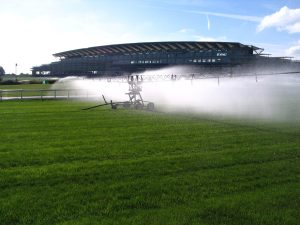
STRI would like to thank everyone involved in the launch of the guide, as well as STRI’s Christian Spring and Steve Gingell for their hard work.
Download the guidance here